Neurofeedback and Auditory Processing in Children
Understanding Auditory Processing
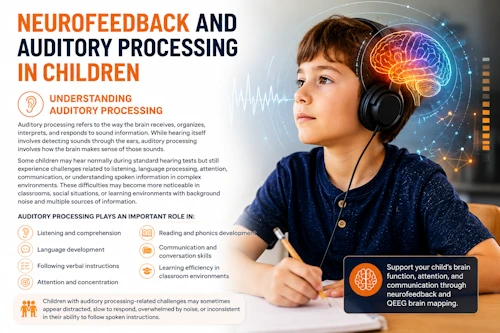
Auditory processing refers to the way the brain receives, organizes, interprets, and responds to sound information. While hearing itself involves detecting sounds through the ears, auditory processing involves how the brain makes sense of those sounds.
Some children may hear normally during standard hearing tests but still experience challenges related to listening, language processing, attention, communication, or understanding spoken information in complex environments. These difficulties may become more noticeable in classrooms, social situations, or learning environments with background noise and multiple sources of information.
Auditory processing plays an important role in:
- Listening and comprehension
- Language development
- Following verbal instructions
- Attention and concentration
- Reading and phonics development
- Communication and conversation skills
- Learning efficiency in classroom environments
Children with auditory processing-related challenges may sometimes appear distracted, slow to respond, overwhelmed by noise, or inconsistent in their ability to follow spoken instructions.
How the Brain Processes Sound
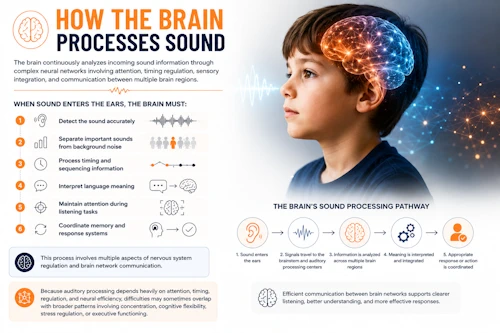
The brain continuously analyzes incoming sound information through complex neural networks involving attention, timing regulation, sensory integration, and communication between multiple brain regions.
When sound enters the ears, the brain must:
- Detect the sound accurately
- Separate important sounds from background noise
- Process timing and sequencing information
- Interpret language meaning
- Maintain attention during listening tasks
- Coordinate memory and response systems
This process involves multiple aspects of nervous system regulation and brain network communication.
Because auditory processing depends heavily on attention, timing, regulation, and neural efficiency, difficulties may sometimes overlap with broader patterns involving concentration, cognitive flexibility, stress regulation, or executive functioning.
QEEG Brain Mapping and Auditory Processing
QEEG Brain Mapping (Quantitative EEG) is an advanced EEG analysis method that evaluates brain activity patterns relative to age-matched normative databases.
QEEG analysis may help identify objective patterns associated with:
- Attentional instability
- Timing irregularities
- Connectivity differences
- Functional network inefficiencies
- Stress-related hyperarousal
- Difficulties involving self-regulation and cognitive processing
Modern QEEG analysis may assess:
- Brainwave activity patterns
- Connectivity relationships
- Coherence regulation
- Phase timing patterns
- Functional organization of neural networks
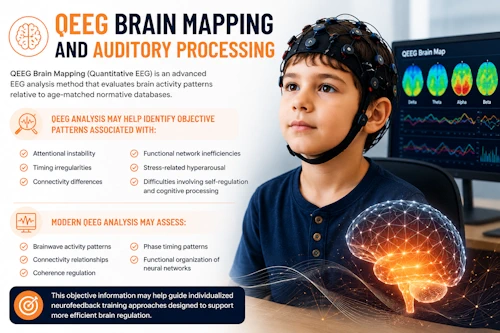
This objective information may help guide individualized neurofeedback training approaches designed to support more efficient brain regulation.

What Is Neurofeedback?
Neurofeedback is a non-invasive form of brain training that uses real-time EEG feedback to support self-regulation and nervous system stability.
During a neurofeedback session, sensors are placed on the scalp to monitor electrical brain activity. The child then receives visual or auditory feedback from the computer while the brain practices producing more stable and adaptive activity patterns.
Neurofeedback does not force the brain into a particular state. Instead, it provides real-time feedback that may help the brain improve its own self-regulation and efficiency over time.
Training protocols are typically individualized based on assessment findings, QEEG analysis, symptom patterns, and overall nervous system regulation.
Auditory Processing and Brain Regulation
Auditory processing involves more than hearing alone. Efficient listening and communication depend on multiple systems working together in a coordinated manner.
These systems may include:
- Attention regulation
- Sensory processing
- Timing and sequencing
- Working memory
- Emotional regulation
- Language processing
- Cognitive flexibility
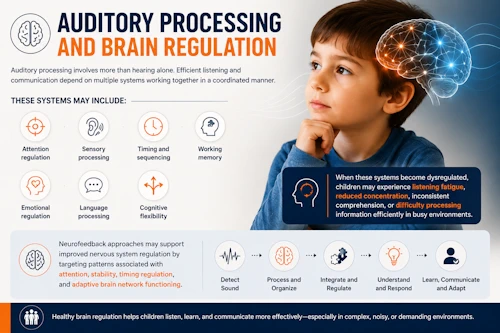
When these systems become dysregulated, children may experience listening fatigue, reduced concentration, inconsistent comprehension, or difficulty processing information efficiently in busy environments.
Neurofeedback approaches may support improved nervous system regulation by targeting patterns associated with attention, stability, timing regulation, and adaptive brain network functioning.

Potential Areas of Support
Research continues to investigate how neurofeedback and QEEG-guided approaches may support various aspects of cognitive and nervous system functioning in children.
Potential areas commonly explored include:
- Attention and concentration
- Listening and communication regulation
- Stress resilience
- Emotional regulation
- Cognitive flexibility
- Executive functioning
- Sleep regulation
- Academic performance
- Nervous system stability
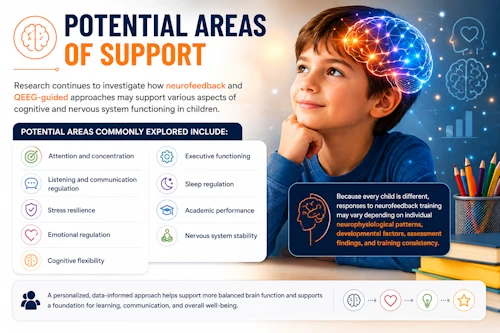
Because every child is different, responses to neurofeedback training may vary depending on individual neurophysiological patterns, developmental factors, assessment findings, and training consistency.

Why Individualized Training Matters
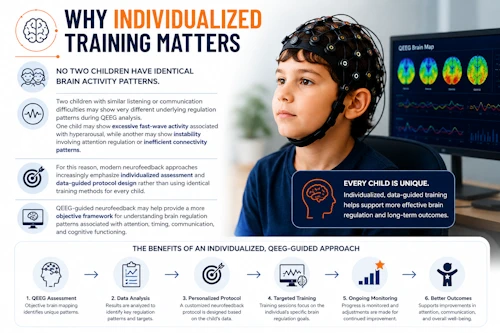
No two children have identical brain activity patterns.
Two children with similar listening or communication difficulties may show very different underlying regulation patterns during QEEG analysis. One child may show excessive fast-wave activity associated with hyperarousal, while another may show instability involving attention regulation or inefficient connectivity patterns.
For this reason, modern neurofeedback approaches increasingly emphasize individualized assessment and data-guided protocol design rather than using identical training methods for every child.
QEEG-guided neurofeedback may help provide a more objective framework for understanding brain regulation patterns associated with attention, timing, communication, and cognitive functioning.

Auditory Processing and Learning Environments
Children spend a large portion of their day in environments filled with auditory information.
Classrooms often contain:
- Background conversations
- Multiple simultaneous sounds
- Rapid verbal instruction
- Social interaction demands
- Attention-switching requirements
- High cognitive load
Children experiencing auditory processing-related difficulties may become mentally fatigued more quickly in these environments.
Supporting nervous system regulation, attentional stability, and adaptive processing efficiency may help children better manage complex listening environments and learning demands.
The Role of Neuroplasticity
Neurofeedback is based on the principle of neuroplasticity, which refers to the brain’s ability to adapt and reorganize based on experience.
As children receive feedback about their brain activity and practice more adaptive regulation patterns, the brain may gradually strengthen more efficient neural pathways and network organization.
Neuroplasticity is one reason why repeated training and consistency are often emphasized in brain-based training approaches.
The brain is dynamic and continuously adapting throughout development, particularly during childhood.
A Supportive and Non-Invasive Approach
Neurofeedback is generally considered a non-invasive training method because it does not involve medication or direct stimulation of the brain.
The training process focuses on providing feedback about ongoing brain activity while encouraging improved self-regulation and adaptive functioning.
Many families are interested in approaches that emphasize:
- Objective assessment
- Individualized protocols
- Brain regulation
- Nervous system stability
- Non-invasive training methods
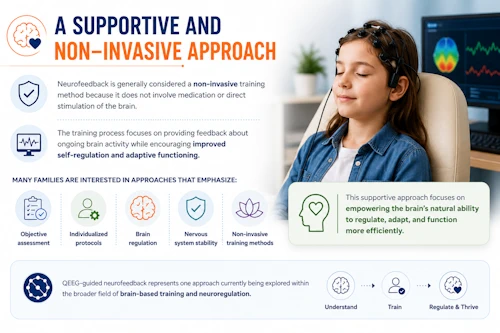
QEEG-guided neurofeedback represents one approach currently being explored within the broader field of brain-based training and neuroregulation.

Conclusion
Auditory processing involves complex interactions between attention, timing regulation, communication systems, memory, and overall nervous system functioning.
Children experiencing auditory processing-related challenges may benefit from supportive approaches that focus on self-regulation, attentional stability, adaptive brain functioning, and nervous system organization.
QEEG Brain Mapping provides objective information about brain activity patterns and network regulation, while neurofeedback training aims to support improved self-regulation through real-time EEG feedback.
Research into neurofeedback, auditory processing, communication regulation, and brain-based training continues to evolve. Modern QEEG-guided neurofeedback approaches increasingly emphasize individualized assessment, objective metrics, and adaptive nervous system regulation as part of a broader neuroregulation framework.
Families interested in learning more about QEEG Brain Mapping and neurofeedback may benefit from consulting qualified professionals experienced in EEG-based assessment and individualized neurofeedback training approaches.