Neurofeedback in Chiang Mai
Using QEEG Brain Mapping and Z-Score Training
We use 19-channel QEEG brain mapping and real-time Z-score neurofeedback to identify and train specific patterns of brain dysregulation. Each protocol is individualized based on your brain data, allowing measurable improvements in attention, emotional regulation, sleep, and cognitive performance.

WHAT IS NEUROFEEDBACK
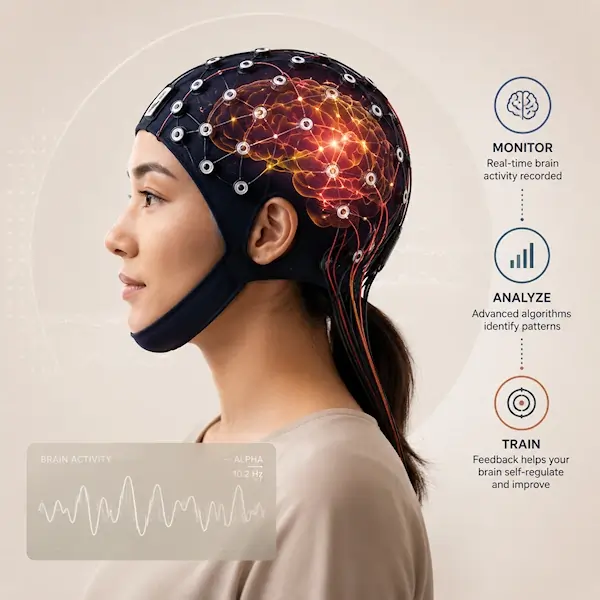
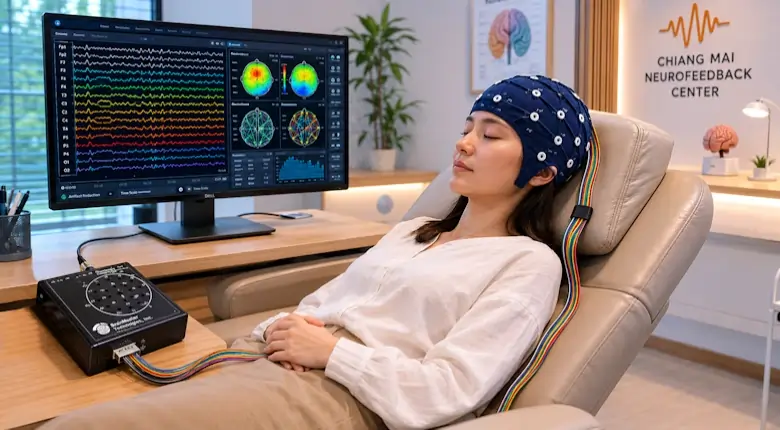
Neurofeedback is a form of operant conditioning applied to brain activity. Using EEG sensors, your brain receives real-time feedback about its electrical patterns and gradually learns to shift toward more stable and efficient functioning.
EEG neurofeedback provides real-time feedback based on your brain’s electrical activity, allowing the brain to adjust its patterns through reinforcement.
Unlike medication, neurofeedback does not impose external changes. Instead, it trains the brain to self-regulate through repeated feedback and reinforcement.
This process is non-invasive, drug-free, and based on measurable brain activity.
Learn more in our Frequently Asked Questions about how neurofeedback works in practice.
Brain Regulation and Self-Regulation Training
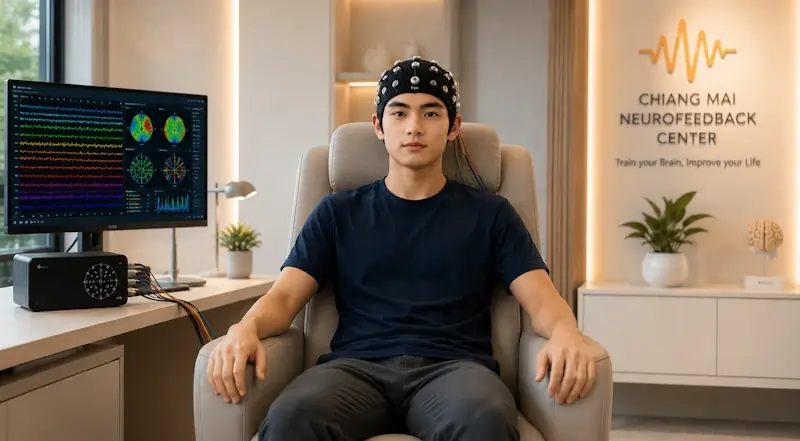
Brain regulation refers to the brain’s ability to maintain stable and efficient patterns of activity across different states — focus, relaxation, emotional response, and sleep.
Dysregulation can appear as:
- Excessive or deficient brainwave activity
- Poor connectivity between brain regions
- Inefficient timing (phase) in neural communication
Neurofeedback targets these patterns directly, helping restore functional balance and improve performance.
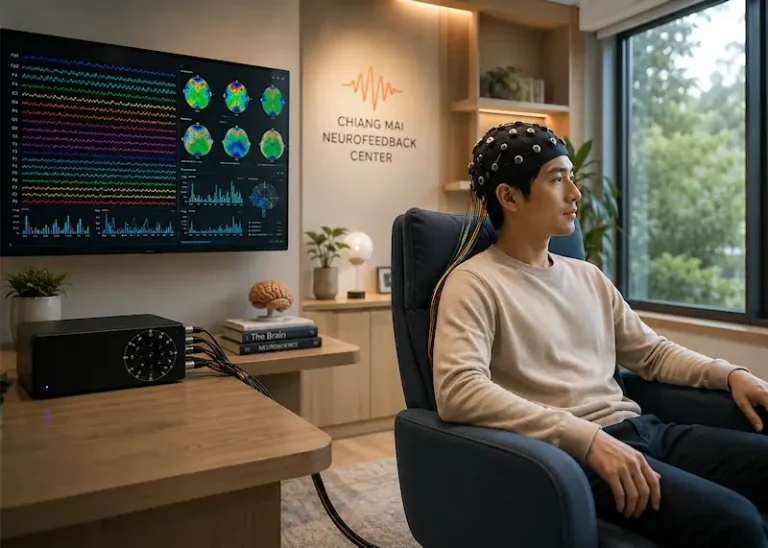
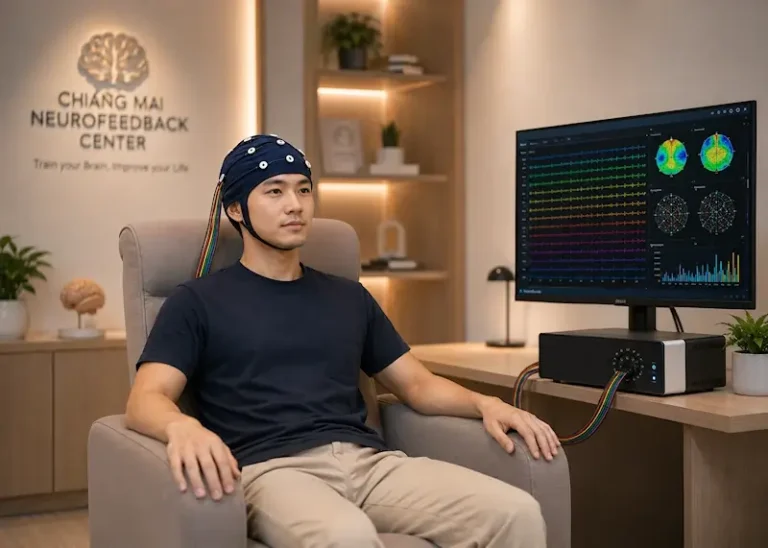
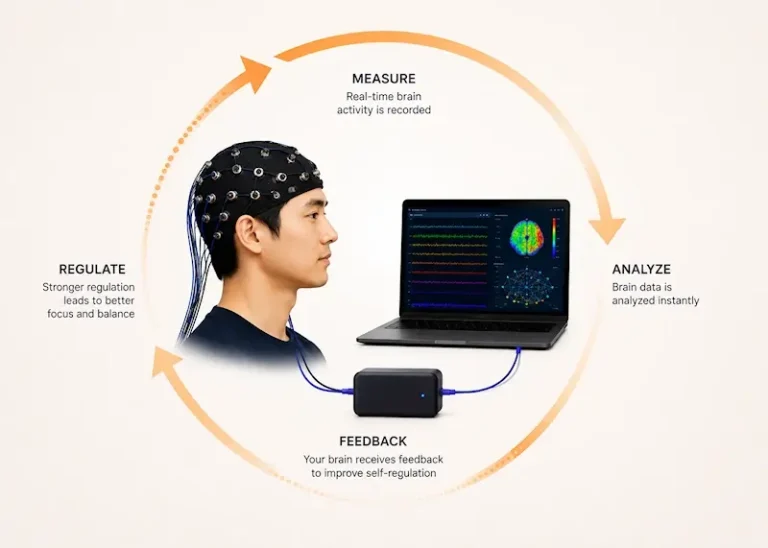
How Neurofeedback Works
During training, EEG sensors monitor your brain activity in real time. The system provides immediate feedback (visual or auditory), reinforcing more optimal brain patterns.
Over repeated sessions:
- Inefficient patterns are reduced
- Stable patterns are strengthened
- Brain networks become more coordinated
This leads to measurable improvements in attention, emotional control, sleep quality, and cognitive efficiency.

EEG (Electroencephalography)
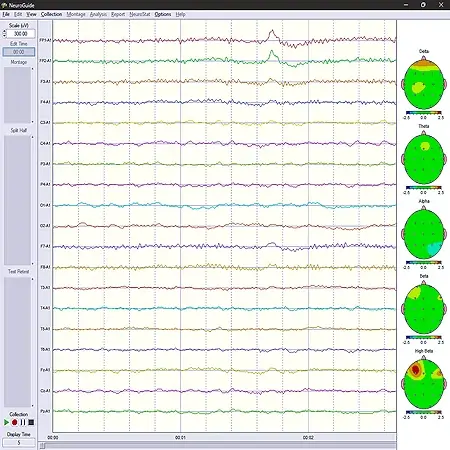
EEG measures the brain’s electrical activity using sensors placed on the scalp. It captures brainwave patterns across multiple frequency bands, including delta, theta, alpha, beta, high-beta and gamma.
EEG provides real-time data used during neurofeedback training, allowing the brain to respond dynamically to feedback.
QEEG Brain Mapping (Quantitative EEG)
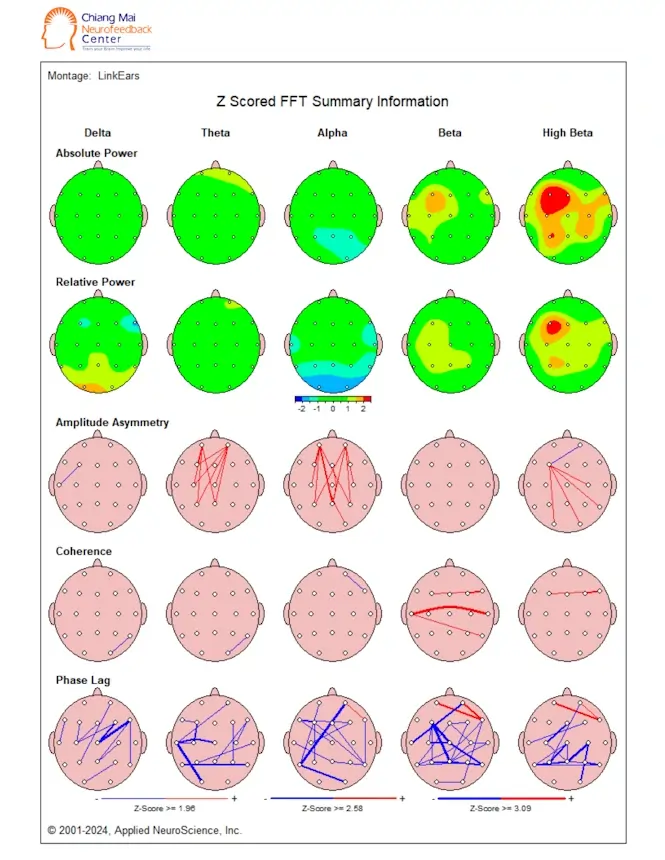
QEEG Brain Mapping (Quantitative EEG) is an advanced EEG analysis method that evaluates brain activity patterns relative to age-matched normative databases. Modern QEEG analysis may assess frequency activity, connectivity relationships, coherence regulation, asymmetry patterns, phase timing, and overall functional organization of the nervous system.
QEEG analysis transforms raw EEG signals into objective functional metrics that may help identify patterns associated with dysregulation, attentional instability, stress-related hyperarousal, inefficient network organization, timing abnormalities, and emotional or cognitive regulation difficulties.
QEEG analysis may help evaluate:
- Brainwave activity patterns
- Connectivity and coherence relationships
- Timing and phase regulation processes
- Functional network organization
- Patterns associated with self-regulation and dysregulation
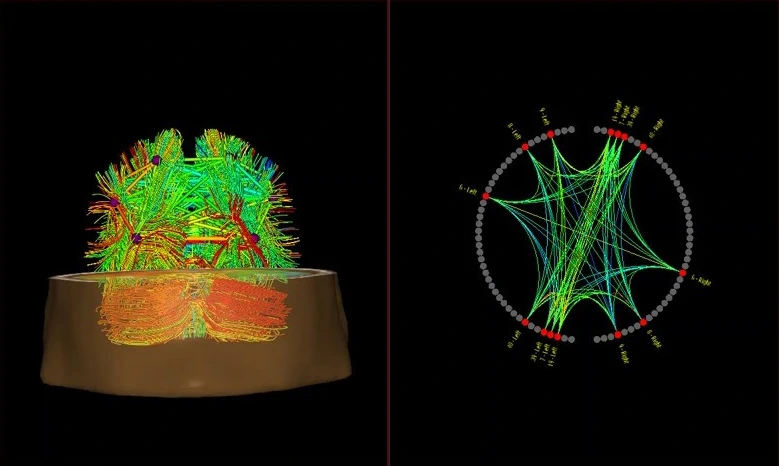


LORETA Brain Imaging (sLORETA / swLORETA)
LORETA (Low Resolution Electromagnetic Tomography) estimates the source of brain activity within deeper cortical regions.
This provides:
- functional localization of brain activity
- insight into specific brain networks
- improved targeting for neurofeedback training
LORETA enhances precision beyond surface EEG analysis.
Normative Database Analysis
Your brain activity is compared against age-matched normative databases to identify statistically significant deviations.
This allows for:
- objective assessment (Z-scores)
- standardized comparison
- data-driven protocol design
Training is guided by measurable changes rather than subjective symptoms.
What Neurofeedback Can Help Improve
Neurofeedback can support improvements in attention and academic performance, emotional regulation, sleep quality, stress resilience, and overall cognitive performance.
It is also commonly used to address patterns associated with depression and other forms of brain dysregulation.
- attention and focus
- emotional regulation
- sleep quality
- stress resilience
- cognitive performance
It is commonly used in both clinical and performance settings.
Why Choose QEEG-Guided Neurofeedback
Unlike generic neurofeedback approaches, QEEG-guided training is based on objective brain data.
This allows:
- individualized protocols
- targeted training of specific brain patterns
- measurable progress over time
The result is a more precise and effective approach to brain regulation.