

Neurofeedback for Insomnia and Sleep Problems in Chiang Mai
Neurofeedback for insomnia approaches sleep problems from a brain-regulation perspective rather than treating them as a single, uniform complaint. In clinical practice, insomnia usually involves a mixture of physiological arousal, cognitive overactivity, emotional tension, poor recovery, and difficulty shifting into a stable sleep state.
Some individuals have trouble falling asleep. Others wake repeatedly, sleep lightly, wake too early, or feel unrefreshed despite spending enough time in bed.
At Chiang Mai Neurofeedback Center, we approach sleep problems from a brain-regulation perspective. We use QEEG brain mapping to assess patterns of brain activity that may be associated with sleep regulation, stress arousal, mental overactivity, and state-shifting difficulties.
Neurofeedback is not a sleeping pill and should not be understood as a direct sedative intervention. The clinical goal is to support better self-regulation over time by helping the brain receive feedback about its own activity.
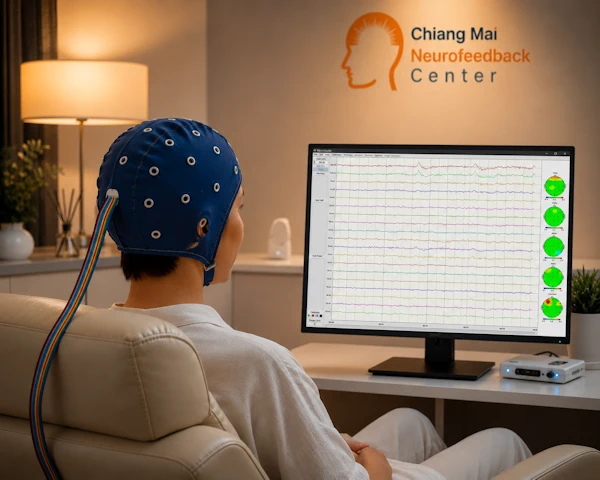
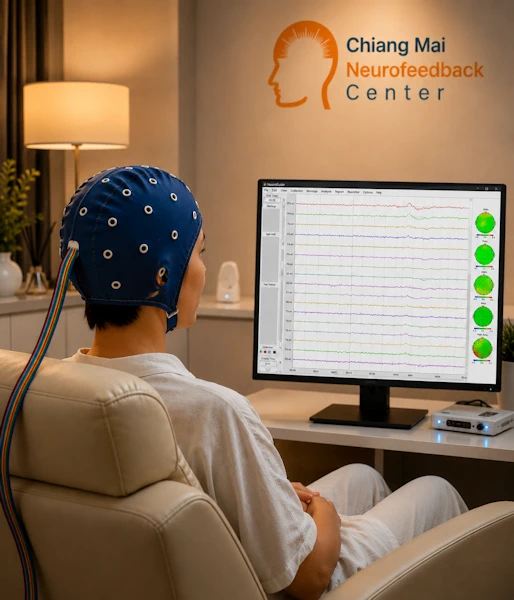
In some individuals, sleep difficulties may be associated with excessive cortical activation, unstable regulation, inefficient slow-wave activity, frontal or temporal asymmetries, or connectivity patterns that correspond with difficulty calming down. In others, QEEG findings may be relatively subtle, mixed, or influenced by medical, medication-related, behavioral, or psychological factors. This is why individualized assessment is essential.
Not sure if neurofeedback is right for your sleep problem?
Start with a brain-function consultation or QEEG brain assessment. We review your symptoms, sleep pattern, history, and main concerns, then explain whether QEEG-guided neurofeedback may be appropriate for your situation.
When Sleep Problems May Be Related to Brain Regulation
Insomnia is not always only a sleep problem. Clinically, many sleep complaints involve difficulty shifting from an active, externally engaged, or internally overactive state into a more regulated resting state.
Some people describe being physically tired but mentally alert. Others notice increased thinking at bedtime, emotional tension, body tension, shallow sleep, or early-morning waking with a sense of being “wired” rather than restored. These patterns may reflect persistent arousal, poor state flexibility, or difficulty downshifting from cognitive and emotional activation.
From a neurophysiological perspective, sleep-related complaints can be associated with several different patterns. Some individuals show excessive fast activity, which may be consistent with cortical hyperarousal. Others may show dysregulated slow activity, reduced stability, asymmetrical activation, or network-level inefficiencies. In some cases, coherence or phase abnormalities may suggest inefficient communication between regions involved in regulation, attention, emotional control, or arousal modulation.
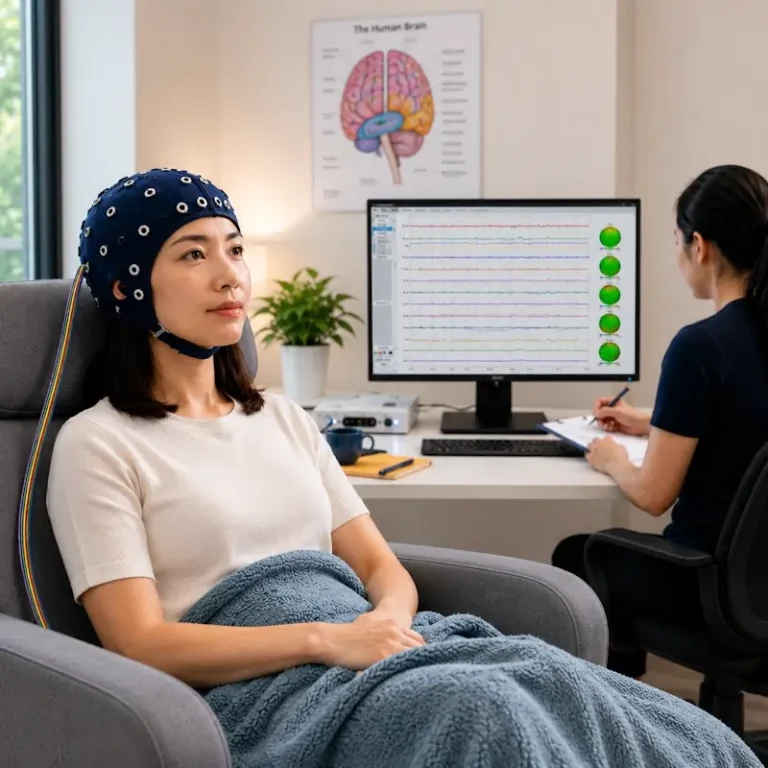
These findings should not be interpreted mechanically. A QEEG pattern does not “diagnose insomnia.” It provides information about brain activity that must be interpreted together with the person’s symptoms, history, medication state, arousal level during recording, sleep schedule, stress load, and real-world functioning.
When interpreted carefully, QEEG can help identify whether neurofeedback training may be clinically reasonable and what type of training approach may be most appropriate.
Who This Page Is For
This page may be relevant if you experience sleep-related problems such as:
- Difficulty falling asleep
- Waking during the night
- Racing thoughts at bedtime
- Light or restless sleep
- Stress-related sleep disruption
- Feeling tired even after sleep
- Brain fatigue from poor sleep
- Difficulty calming down at night
- Poor concentration after bad sleep
- Sleep problems connected with anxiety, burnout, or long-term stress


This page may also be relevant if you have already tried general sleep advice but still feel that your brain does not shift into a restful state easily.
Patterns vary between individuals. One person with insomnia may present with clear signs of physiological hyperarousal. Another may show more fatigue-related dysregulation, unstable attention, emotional over-reactivity, or mixed activation patterns. This is one reason we avoid using one standard protocol for every sleep complaint.
Neurofeedback is not suitable for every sleep problem. If your sleep difficulty may be related to sleep apnea, breathing problems, severe depression, medication effects, alcohol or substance use, chronic pain, hormonal factors, neurological conditions, or another medical issue, medical evaluation may also be needed.
Common Patterns People Describe
People with sleep problems often describe experiences such as:
“I feel tired, but my brain stays active.”
“I wake up during the night and cannot fall back asleep.”
“My thoughts become more active when I go to bed.”
“I sleep, but I do not feel restored.”
“My sleep becomes worse when I am stressed.”
“I wake up feeling wired, anxious, or mentally exhausted.”
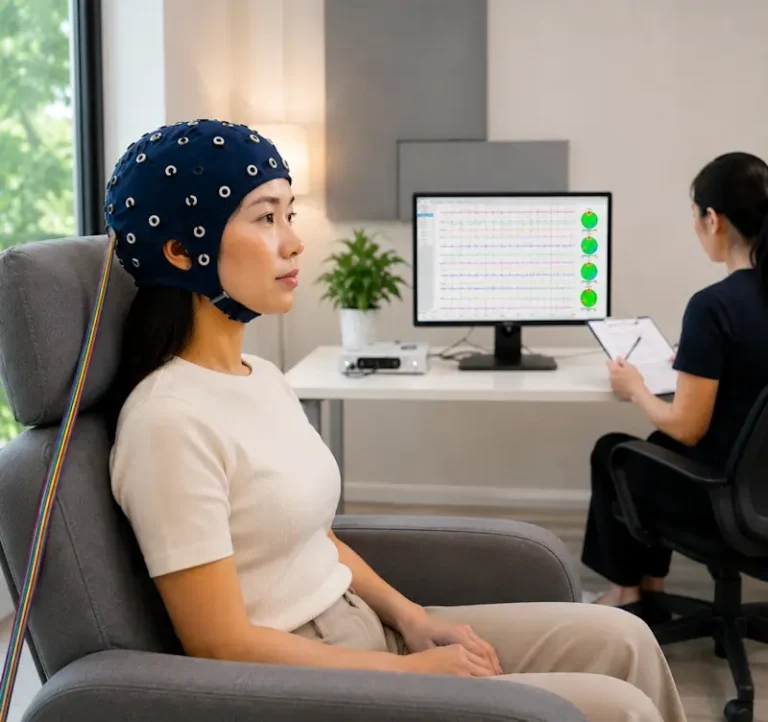
Clinically, these descriptions are important because they help us understand the functional pattern behind the sleep complaint. The same symptom label can reflect different underlying regulation problems.
For example, difficulty falling asleep with racing thoughts may suggest a different training priority than waking after several hours with physical tension or early-morning anxiety. Poor sleep combined with daytime brain fog may require different interpretation than poor sleep combined with agitation, irritability, or panic-like arousal.
This is why QEEG findings are interpreted in relation to the clinical picture rather than treated as isolated numbers.
How QEEG Brain Mapping Helps Us Understand Sleep-Related Patterns
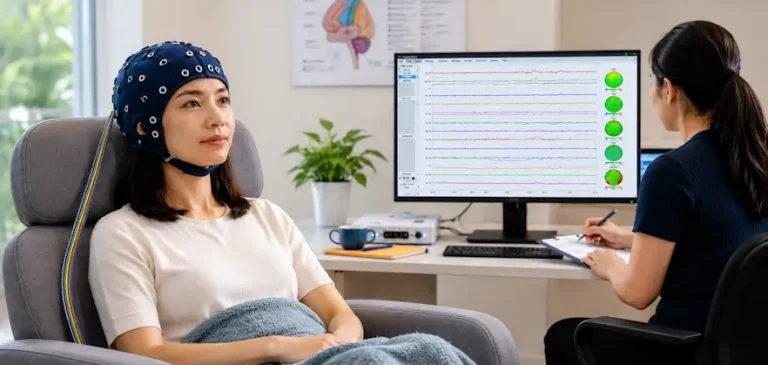
Before starting neurofeedback training, we first assess brain activity. QEEG brain mapping records EEG activity using sensors placed on the scalp. The recorded data is then analyzed and compared with age-matched normative data.
In practice, we are not only looking for a single abnormal value. We look at the broader pattern: amplitude, frequency distribution, asymmetry, coherence, phase relationships, stability, and Z-score deviations across relevant brain regions and networks.
Our QEEG interpretation may include Z-score analysis, coherence, phase relationships, and network-level findings using NeuroGuide-based tools from Applied Neuroscience.
For sleep-related concerns, we review factors such as:
- Symptom history
- Sleep pattern and timing
- Stress and arousal patterns
- Attention and fatigue symptoms
- Emotional regulation symptoms
- Medication or supplement context when relevant
- EEG frequency patterns
- QEEG Z-score deviations
- Coherence and phase relationships
- Possible network-level dysregulation
- Possible neurofeedback training targets
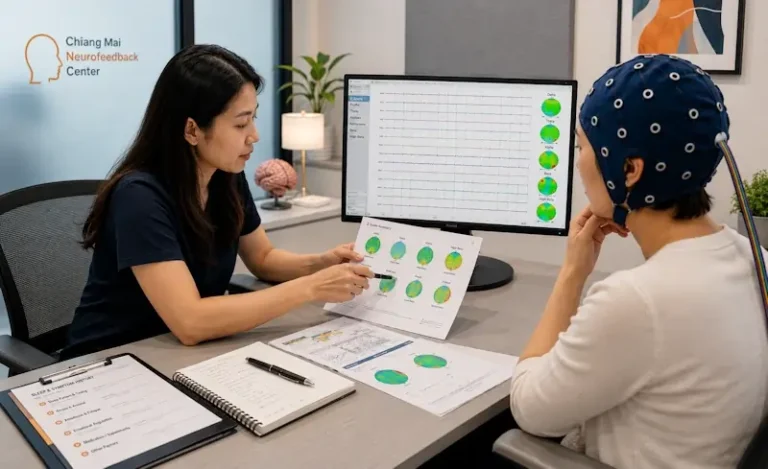
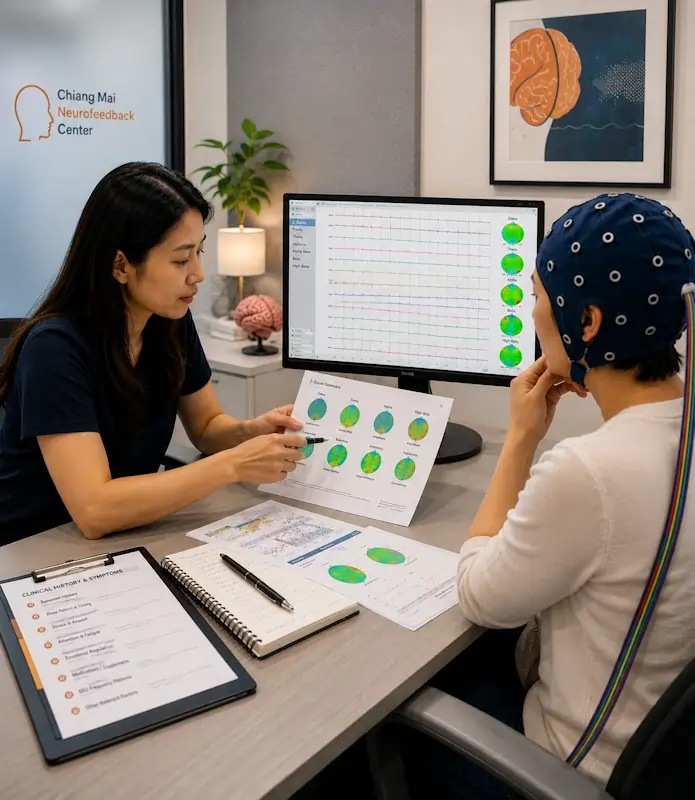
The goal is to understand whether the brain appears overactivated, underregulated, unstable, inefficient, or poorly coordinated in ways that may be clinically relevant to the person’s sleep complaint.
QEEG is not the same as a medical sleep study. A sleep study is used to evaluate medical sleep disorders such as sleep apnea, sleep-related breathing disorders, movement disorders, and other physiological sleep conditions. QEEG brain mapping evaluates waking brain activity patterns and their possible relationship to regulation, arousal, attention, emotional functioning, and cognitive state control.
QEEG does not replace medical diagnosis. Its value is in helping guide individualized neurofeedback training when the clinical picture suggests that brain regulation may be part of the sleep problem.
Why QEEG Findings Must Be Interpreted Individually
Sleep-related QEEG findings are not uniform. Two people may both report insomnia, but their neurophysiological patterns may be very different.
In some individuals, we may see patterns consistent with excessive cortical arousal. In others, the dominant issue may be instability, inefficient slow activity, frontal dysregulation, temporal activation, or connectivity-related abnormalities. Some people show mixed patterns, where fatigue and overactivation appear together. Others may have relatively normal surface EEG findings despite significant sleep complaints.
Interpretation also depends on recording quality and clinical context. Muscle tension, drowsiness, eye movement, medication effects, caffeine, anxiety during recording, poor sleep the previous night, or excessive fatigue can influence EEG data. These factors must be considered before drawing conclusions.
This is one reason QEEG should not be used as a simple “brain test” that automatically produces a treatment plan. It requires clinical interpretation. The findings need to be matched with symptoms, history, functional complaints, observed state, and training response over time.
For neurofeedback, the practical question is not only “what is abnormal?” The more useful question is:
Which brain-regulation pattern appears most relevant to this person’s symptoms, and what training approach is most likely to be tolerated and clinically useful?
How Neurofeedback Training Works for Sleep Problems
Neurofeedback is a non-invasive brain training method. At Chiang Mai Neurofeedback Center, we use individualized neurofeedback in Chiang Mai to support brain self-regulation based on symptoms, QEEG findings, and clinical goals.
The feedback may be visual, auditory, or both. The client does not need to consciously force the brain to change. Instead, the brain receives information about its own activity and can gradually learn more regulated patterns through repeated sessions.
For sleep problems, neurofeedback is usually not about making the person sleepy during the session. The clinical focus is broader: improving self-regulation, reducing excessive arousal when relevant, supporting stability, and helping the nervous system shift more effectively between states.
In practice, the protocol depends on the individual EEG phenotype, symptom pattern, and training response. For one person, the priority may be reducing excessive high-frequency activation. For another, it may involve improving stability, reducing inefficient slow activity, or addressing connectivity-related dysregulation. For someone else, the initial goal may be to train regulation gently because the nervous system is highly reactive or easily fatigued.
This individualized approach matters. Overtraining, poorly selected protocols, or generic relaxation-based assumptions can be counterproductive in sensitive clients. Sleep-related training should be monitored carefully and adjusted according to response.
Neurofeedback Is Different From Sleeping Pills
Sleeping pills and sedating medications may help some people fall asleep in the short term. They can be clinically useful in appropriate situations when prescribed and monitored by a qualified medical professional.
Neurofeedback works from a different angle. It does not chemically sedate the brain. It aims to support brain self-regulation through repeated feedback-based learning.
This distinction is important. Neurofeedback should not be presented as a substitute for medication, medical care, or sleep medicine evaluation. It may be considered as a supportive brain-training approach when sleep difficulties appear to involve regulation, arousal, stress reactivity, or state-shifting problems.
Results are not instant and are not guaranteed. Some people notice changes relatively early, while others require more sessions before meaningful changes appear. Some may not respond sufficiently. Training response can be influenced by symptom severity, medical factors, psychological stress, medication, sleep habits, alcohol use, nervous-system sensitivity, and the accuracy of protocol selection.
The purpose of assessment is to determine whether QEEG-guided neurofeedback is a reasonable option for the individual, not to assume that every sleep problem should be trained the same way.
What to Expect at Chiang Mai Neurofeedback Center
Step 1: Brain-Function Consultation or QEEG Brain Assessment
We begin by reviewing your symptoms, sleep history, stress level, lifestyle factors, and main concerns. We look at when the sleep problem started, what makes it worse, what has helped, and whether other symptoms are present.
These may include anxiety, burnout, attention problems, emotional reactivity, fatigue, headaches, trauma history, medication use, or difficulty recovering from stress.
The consultation helps us understand whether the sleep complaint appears primarily behavioral, medical, stress-related, neurophysiological, or mixed.
Step 2: QEEG Brain Mapping
EEG is recorded using a 19-channel cap. The data is analyzed to identify brain activity patterns that may be relevant to your symptoms.
We review frequency patterns, regional activation, asymmetry, Z-score deviations, coherence, phase relationships, and network-level findings where clinically relevant. These findings are interpreted alongside your symptoms and history.
The brain map does not replace medical diagnosis. It helps guide clinical reasoning and individualized neurofeedback planning.
Step 3: Individualized Training Plan
Your neurofeedback protocol is based on your QEEG results, symptoms, and clinical goals.
For sleep-related problems, training may focus on improving regulation, calming excessive arousal, supporting stability, improving state flexibility, or addressing network-level inefficiencies that appear clinically relevant.
The protocol is not chosen only because the person reports insomnia. It is chosen based on the combination of QEEG findings, clinical presentation, and training tolerance.
Step 4: Neurofeedback Training Sessions
Training sessions are repeated over time. During sessions, sensors measure brain activity while the feedback system provides information to the brain.
The process is non-invasive. The sensors record brain activity; they do not put electricity into the brain.
Training is monitored carefully. Some clients respond best to direct regulation training. Others require slower adjustments because their nervous system is reactive, fatigued, or sensitive to changes in arousal state.
For general questions about session length, safety, and how neurofeedback training is structured, see our common questions about neurofeedback.
Step 5: Progress Review and Protocol Adjustment
Progress is reviewed over time. We look at changes in sleep onset, night waking, sleep depth, morning recovery, daytime fatigue, emotional regulation, stress tolerance, and cognitive function.
Protocol adjustment is often part of responsible neurofeedback. Brain training is not a static process. As regulation changes, training targets may need to be refined.
When Medical Evaluation May Also Be Needed
Neurofeedback does not replace medical diagnosis or treatment. Sleep problems can have many causes, and some require medical evaluation.
Medical evaluation may be needed if sleep problems are related to:
- Loud snoring or breathing pauses during sleep
- Suspected sleep apnea
- Severe daytime sleepiness
- Breathing problems during sleep
- Chronic pain
- Medication effects
- Alcohol or substance use
- Hormonal or metabolic problems
- Neurological conditions
- Severe depression or psychiatric symptoms
- Sudden major changes in sleep pattern


If a medical sleep disorder is suspected, we may recommend that you also consult a qualified medical professional or sleep specialist.
A responsible approach to sleep problems should not assume that every case is suitable for neurofeedback. Some clients may benefit from neurofeedback as part of a broader care plan. Others may need medical evaluation first.
What Neurofeedback May Support
For suitable clients, neurofeedback may support better brain self-regulation. Depending on the person, this may be relevant to:
- Calming excessive mental activity
- Reducing stress-related arousal
- Improving nervous-system regulation
- Supporting more stable brain activity
- Improving state flexibility
- Supporting sleep readiness
- Reducing brain fatigue related to poor sleep
- Supporting attention and emotional regulation affected by poor sleep


These are functional goals, not guaranteed outcomes. Neurofeedback should not be described as a cure for insomnia. It may help some individuals train brain-regulation patterns that are clinically relevant to sleep, especially when poor sleep is associated with arousal, stress reactivity, overthinking, or unstable regulation.
The best results usually come when neurofeedback is combined with appropriate sleep routines, stress management, realistic expectations, and medical care when needed.
Common Questions About Neurofeedback and Insomnia
Can neurofeedback cure insomnia?
No. Neurofeedback should not be described as a cure for insomnia. The goal is to support better brain self-regulation, which may help some individuals with sleep-related symptoms. Results vary depending on the person, the underlying causes of the sleep problem, QEEG findings, and training response.
Is QEEG the same as a sleep study?
No. QEEG brain mapping records and analyzes waking brain activity patterns. A medical sleep study is different and may be needed to diagnose conditions such as sleep apnea, sleep-related breathing problems, movement disorders, or other sleep disorders.
How many neurofeedback sessions are needed for sleep problems?
The number of sessions depends on the person, QEEG findings, symptom severity, training response, and whether other medical or lifestyle factors are involved. Some people begin with a smaller block of sessions before deciding whether to continue with a longer training plan.
Does neurofeedback replace sleeping pills?
No. Neurofeedback does not replace medication or medical care. Medication decisions should be made with your prescribing doctor. Neurofeedback works differently by aiming to support brain self-regulation over time.
Can I do neurofeedback while taking sleep medication?
In many cases, neurofeedback can be done while a person is taking medication, but medication should always be discussed with the prescribing doctor. Medication can influence sleep, arousal, and EEG patterns, so we take medication context into account when reviewing symptoms and training response.
Is neurofeedback safe?
Neurofeedback is non-invasive. Sensors record brain activity; they do not put electricity into the brain. Training should still be individualized and monitored properly, especially in people with complex symptoms, medication use, neurological history, or high nervous-system sensitivity.
Is neurofeedback suitable for everyone with insomnia?
No. Some sleep problems require medical evaluation first. If symptoms suggest sleep apnea, severe psychiatric symptoms, medication effects, substance-related sleep disruption, chronic pain, neurological illness, or another medical condition, medical assessment may be needed.
Why Choose Chiang Mai Neurofeedback Center?
Chiang Mai Neurofeedback Center uses a measurement-based approach. We do not use the same protocol for every client with sleep problems. We begin with symptom review and QEEG brain mapping so that training can be individualized according to the person’s brain activity patterns, clinical presentation, and goals.
Our approach is especially relevant for people who want to understand their sleep problem from a brain-regulation perspective rather than relying only on general sleep advice.
We focus on:
- QEEG-guided assessment
- Individualized neurofeedback protocols
- Brain self-regulation training
- Careful symptom review
- Z-score informed interpretation
- Network-level clinical reasoning
- Progress tracking over time
- Responsible medical boundaries
- Clear explanation before training begins


Neurofeedback is not magic, and it is not a quick fix. But for suitable clients, it may be a useful brain-based training approach when sleep problems are associated with stress arousal, racing thoughts, emotional reactivity, brain fatigue, and difficulty shifting into a calmer state.
Start With a Brain-Function Consultation or QEEG Brain Assessment
Not sure if neurofeedback is right for your sleep problem?
Start with a brain-function consultation or QEEG brain assessment. We review your symptoms, sleep pattern, history, and main concerns, then explain whether QEEG-guided neurofeedback may be appropriate for your situation.
Book QEEG Brain Assessment
Contact Us on LINE or WhatsApp
Chiang Mai Neurofeedback Center provides QEEG brain mapping and individualized neurofeedback training for clients with concerns such as sleep problems, attention difficulties, stress regulation issues, emotional reactivity, brain fatigue, and related brain-function concerns.
Final Considerations
QEEG-guided neurofeedback attempts to integrate objective EEG analysis with individualized functional interpretation. Rather than assuming that all sleep problems arise from the same mechanism, this approach emphasizes variability between individuals and the importance of assessing brain regulation, arousal patterns, and network-level findings in clinical context.
Clinically, similar sleep complaints may involve substantially different underlying regulation patterns. In some individuals, insomnia may be associated with excessive cortical arousal or difficulty downshifting into a calmer state. In others, sleep disruption may be influenced by stress load, medication effects, medical conditions, emotional regulation, fatigue, or other factors that require broader clinical consideration.
For readers who want to explore the broader professional literature, the International Society for Neuroregulation & Research provides a comprehensive bibliography of neurofeedback research.
This article is intended for informational and educational purposes only and should not substitute for individualized medical evaluation, diagnosis, or treatment advice.
Reviewed and published by Chiang Mai Neurofeedback Center, a neurofeedback and QEEG clinic in Chiang Mai, Thailand specializing in individualized neurofeedback protocols, QEEG brain mapping, functional connectivity assessment, and brain regulation analysis.