

Dyslexia: When the Brain Reads Differently —
A Neurofeedback and QEEG Perspective
Dyslexia is not a matter of laziness or insufficient effort, and it does not reflect a child’s intelligence. Many children with dyslexia are bright, curious, and learn other things well — yet struggle specifically with reading and spelling.
Neurologically, dyslexia involves the brain’s reading network functioning differently from typical readers. Understanding this mechanism helps parents see the problem accurately and opens the way to appropriate support.

Reading Is the Work of Multiple Brain Networks
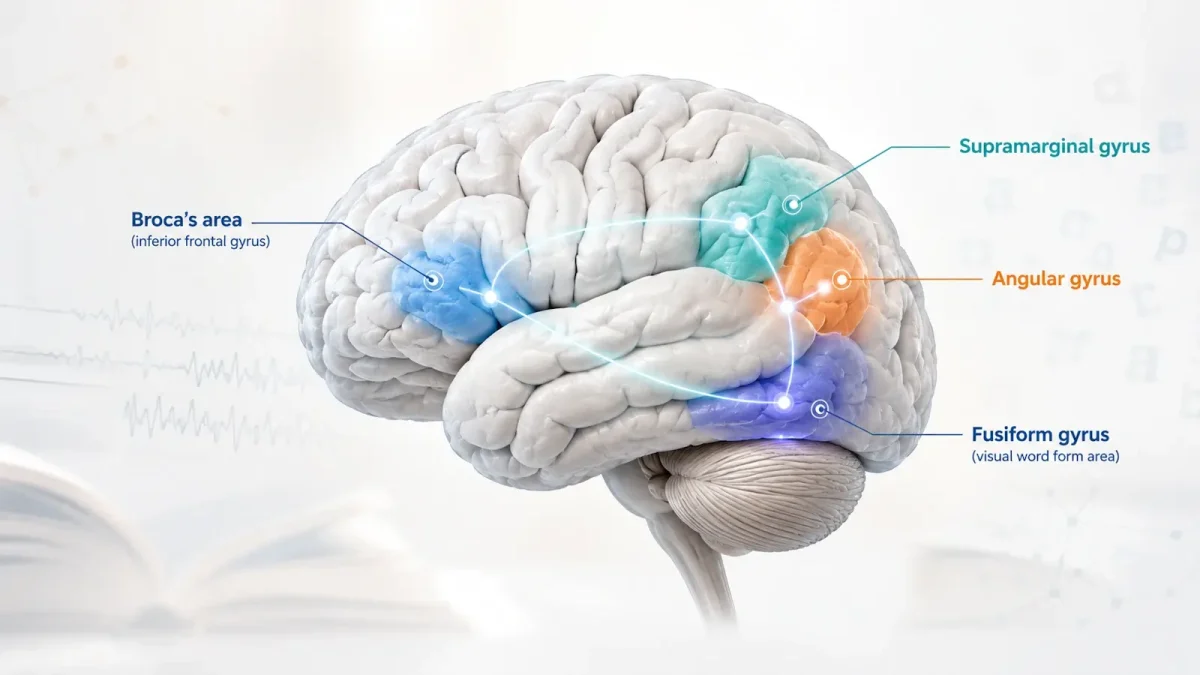
Reading does not use a single part of the brain. It relies on several regions working together, particularly in the left hemisphere. Neuroimaging research identifies the regions most involved in reading as the inferior frontal, temporo-parietal, and occipito-temporal areas of the left hemisphere.
- Brodmann Area 39 and Brodmann Area 40 (the angular and supramarginal gyri, in the temporo-parietal region) help link the letters we see to their sounds and meanings.
- Brodmann Area 37 (the fusiform gyrus) is the location of the visual word form area, which lets skilled readers recognise word shapes quickly and automatically.
- Brodmann Area 44 and Brodmann Area 45 (the inferior frontal gyrus / Broca’s area) are involved in phonological processing — the sound structure of language. This phonological dimension is one reason reading difficulty can overlap with auditory processing differences in children, since both involve how the brain handles the sounds of language.
In children with dyslexia, research finds that the two posterior left-hemisphere systems — parieto-temporal and occipito-temporal — often underfunction, with the brain sometimes compensating through greater activity in the anterior region around the inferior frontal gyrus. The result is that converting letters into sounds and meaning is slower and takes more effort than usual.
Importantly, researchers stress that dyslexia is unlikely to have a single cause, and that individual children may have different patterns of weakness — which is a key reason why Neurofeedback and QEEG Brain Mapping assessment should be individualised.
QEEG Brain Mapping and Dyslexia
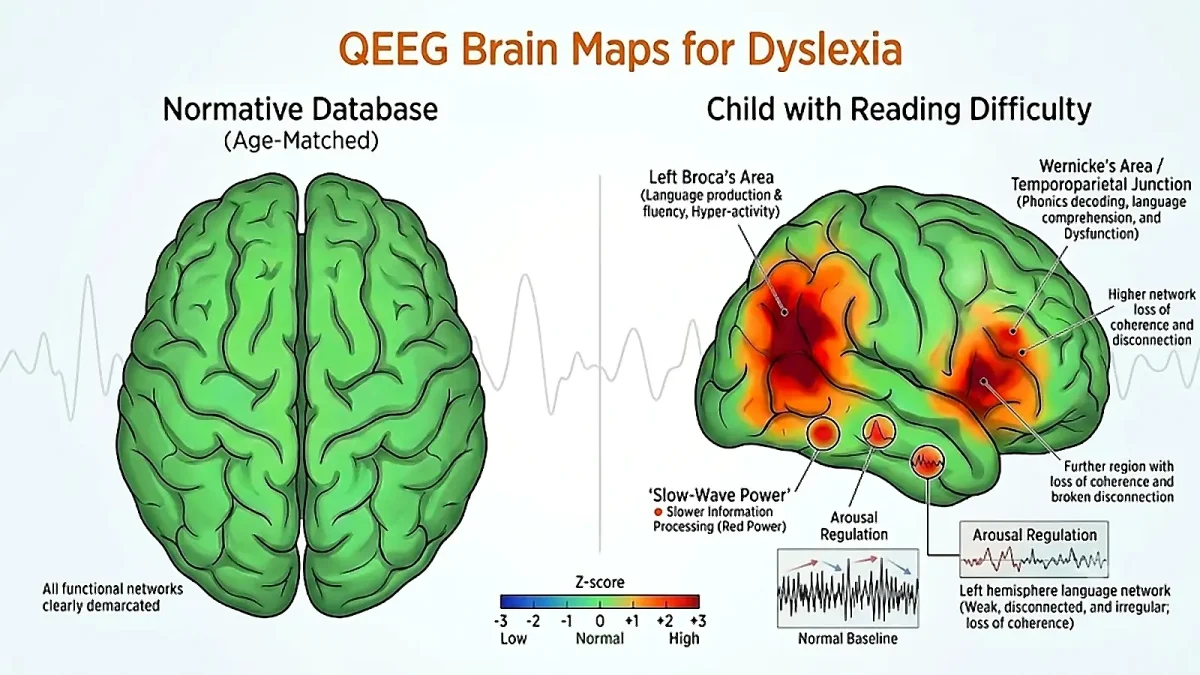
QEEG brain mapping allows a more detailed view of the brain-activity patterns involved in reading. In our clinical work at the center over the past several years, we often observe that children with reading difficulty show different patterns from case to case. We may see:
- Anomalies of coherence or connectivity within the left-hemisphere language network
- Power patterns reflecting slowed information processing in certain regions
- Instability of arousal regulation that affects attention during reading
However, these patterns must be interpreted together with the child’s history, behaviour, and individual context. QEEG is not a standalone diagnostic tool — it is supporting information that helps us understand brain function and design individualised support.
At Chiang Mai Neurofeedback Center, we provide QEEG Brain Mapping assessment for children with reading difficulty, to help clarify each child’s individual brain-activity patterns and to inform an individualised plan of support.
Neurofeedback and Dyslexia: What the Science Says
Neurofeedback trains the brain to regulate its own activity through real-time EEG feedback. In relation to dyslexia and reading difficulty, the research is still developing, but some studies have reported encouraging findings, especially when training is individualized and guided by QEEG assessment.
A randomized controlled trial by Coben et al. (2015) in 42 children with learning disabilities reported that the group receiving QEEG-guided left-hemisphere coherence neurofeedback showed improvement in reading scores compared with a control group receiving typical supplementary instruction, with an average reported gain of approximately 1.2 grade levels after 20 sessions.¹ A 2024 systematic review of 39 studies involving 342 children reported that neurofeedback may have positive effects on functioning and participation in some children with dyslexia, particularly when considered as part of a broader multidimensional approach.² However, these findings should not be interpreted as a guarantee of outcome for every child, and neurofeedback should not replace educational assessment, structured reading intervention, speech-language evaluation, developmental assessment, or other appropriate professional support.
A clinically important theme in this research is the value of individualized planning. In practice, QEEG-guided approaches may be more clinically informative than one-size-fits-all protocols because they allow the practitioner to consider the child’s EEG pattern, symptom profile, developmental history, tolerance, and response to training.
At our center, we therefore do not use a fixed protocol for every child with reading difficulty. The training approach is determined from the child’s QEEG findings, functional presentation, learning history, and response over time.
Parents should also understand the limits clearly. Although the findings point in a positive direction, the overall evidence base remains smaller than for established educational reading interventions. Neurofeedback is best understood as a supportive adjunct for attention, self-regulation, arousal stability, and learning readiness, alongside structured reading instruction and educational support.
Further information on professional standards and neurofeedback research is available from ISNR (International Society for Neuroregulation & Research).
Dyslexia Is One Type of Learning Disorder
Dyslexia is classified as one type of learning disorder (LD), specifically affecting reading. Some children may also have related difficulties, such as speech and language development.
Signs Parents Can Notice
Dyslexia usually becomes apparent when a child begins learning to read. Common signs include:
- Slow, effortful reading despite normal intelligence
- Confusing or reversing similar letters, even past age 7
- Frequent spelling errors and difficulty remembering word forms
- Avoiding reading activities, or showing stress when reading aloud
- Understanding well when read to, but struggling when reading independently
Reading difficulty often affects overall academic performance, so if a child shows these signs, early assessment helps with appropriate planning before discouragement accumulates.
If your child shows these signs, a QEEG assessment can help clarify how their brain is functioning. You’re welcome to contact us to ask questions or arrange an assessment.
Final Considerations
QEEG-guided neurofeedback aims to combine objective EEG data with a functional interpretation of the individual child, rather than assuming that every child with reading difficulty shares the same underlying mechanism. This approach gives weight to individual differences, to the brain’s reading-network patterns, and to the real-world context of behaviour, learning, and reading.
Clinically, children with similar symptoms can show very different brain-activity patterns. QEEG interpretation therefore calls for caution: no conclusion should rest on a single number or a single brain map. Findings are considered alongside developmental history, reading, spelling, language, attention, and how the child actually functions day to day.
This article is intended for educational and general-information purposes only. It is not a substitute for individual medical assessment, diagnosis, or specific advice. If parents have concerns about a child’s reading, learning, or development, they should consult a relevant developmental or learning specialist for appropriate assessment.
Published by Chiang Mai Neurofeedback Center, a neurofeedback and QEEG clinic in Chiang Mai that focuses on individualised brain assessment, careful QEEG interpretation, functional connectivity analysis, and neurofeedback programs designed around each child’s own brain-activity patterns. To ask questions or arrange an assessment, please contact Chiang Mai Neurofeedback Center.
References
- Coben R, Wright EK, Decker SL, Morgan T. The Impact of Coherence Neurofeedback on Reading Delays in Learning Disabled Children: A Randomized Controlled Study. NeuroRegulation. 2015;2(4):168. DOI: 10.15540/nr.2.4.168 — https://doi.org/10.15540/nr.2.4.168
- Joveini G, Shahverdi M, Sayyahi F, Heidarpour F, Hojati Abed E. Systematic review of neurofeedback interventions for dyslexia. Applied Neuropsychology: Child. 2024. PMID: 39708345 — https://pubmed.ncbi.nlm.nih.gov/39708345/