

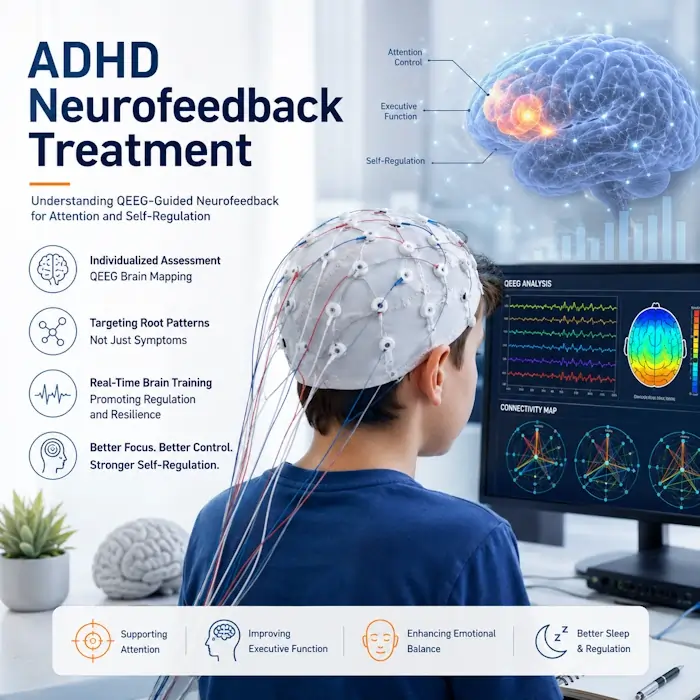
ADHD Neurofeedback Treatment
Understanding QEEG-Guided Neurofeedback for Attention and Self-Regulation
Attention-deficit and hyperactivity-related symptoms can affect multiple aspects of daily functioning, including attention regulation, emotional control, executive functioning, impulse regulation, sleep quality, and cognitive consistency. These patterns may present differently between individuals and across age groups, which is one reason why comprehensive assessment is important when considering neurofeedback approaches.
Neurofeedback is a form of brain-based training that provides real-time feedback about brain activity patterns. In clinical settings, neurofeedback is often used as part of a broader functional self-regulation approach rather than as a standalone intervention focused solely on symptom reduction.
QEEG-guided neurofeedback attempts to individualize training by evaluating patterns of brain activity, connectivity, timing relationships, and regulatory dynamics before training protocols are developed. Rather than assuming that all individuals with attention-related symptoms demonstrate the same neurophysiological profile, QEEG assessment may help identify which functional networks appear most dysregulated in a particular individual.
At Chiang Mai Neurofeedback Center, neurofeedback protocols are individualized using objective EEG analysis and functional connectivity assessment methodologies.
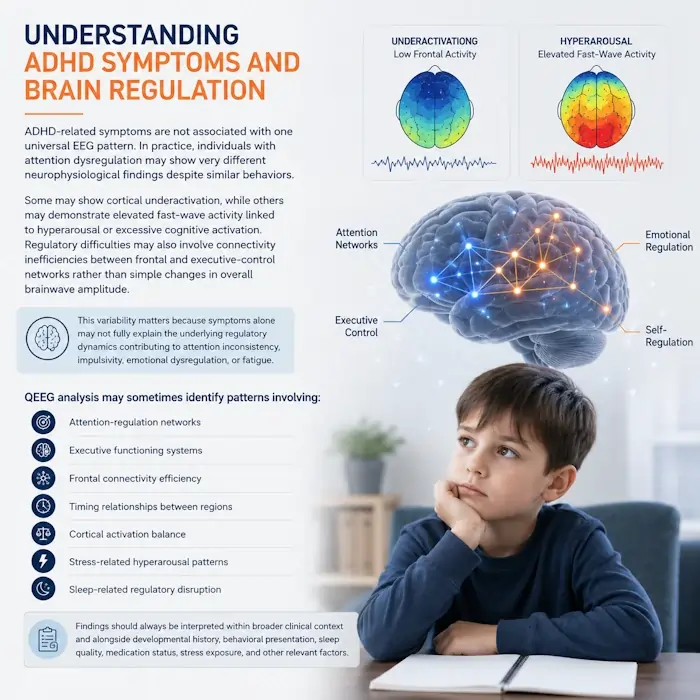
Understanding ADHD Symptoms and Brain Regulation
ADHD-related symptoms are not associated with one universal EEG pattern. In practice, individuals presenting with attention dysregulation may demonstrate substantially different underlying neurophysiological findings despite having similar behavioral symptoms.
Some individuals may demonstrate patterns associated with cortical underactivation, while others may exhibit elevated fast-wave activity associated with hyperarousal or excessive cognitive activation. In some cases, regulatory difficulties may involve functional connectivity inefficiencies between frontal and executive-control networks rather than simple changes in overall brainwave amplitude.
Clinically, this variability is important because symptom presentation alone may not fully explain the underlying regulatory dynamics contributing to attentional inconsistency, impulsivity, emotional dysregulation, or cognitive fatigue.
QEEG analysis may sometimes identify patterns involving:
- attention-regulation networks
- executive functioning systems
- frontal connectivity efficiency
- timing relationships between regions
- cortical activation balance
- stress-related hyperarousal patterns
- sleep-related regulatory disruption
However, findings should always be interpreted within broader clinical context and alongside developmental history, behavioral presentation, sleep quality, medication status, stress exposure, and other relevant factors.
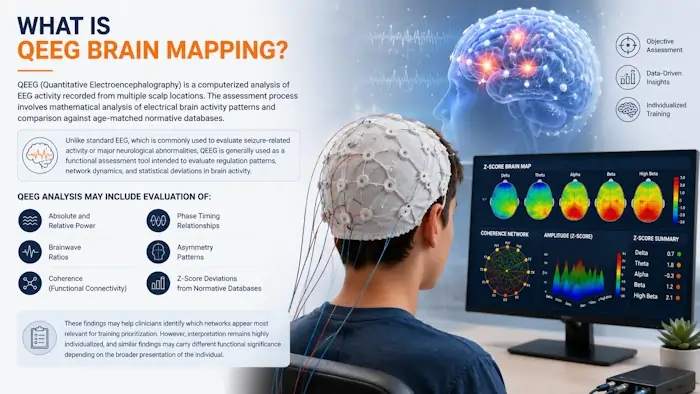
What Is QEEG Brain Mapping?
QEEG (Quantitative Electroencephalography) is a computerized analysis of EEG activity recorded from multiple scalp locations. The assessment process involves mathematical analysis of electrical brain activity patterns and comparison against age-matched normative databases.
Unlike standard EEG, which is commonly used to evaluate seizure-related activity or major neurological abnormalities, QEEG is generally used as a functional assessment tool intended to evaluate regulation patterns, network dynamics, and statistical deviations in brain activity.
QEEG analysis may include evaluation of:
- absolute and relative power
- brainwave ratios
- coherence (functional connectivity)
- phase timing relationships
- asymmetry patterns
- Z-score deviations from normative databases
In practice, these findings may help clinicians identify which networks appear most relevant for training prioritization. However, interpretation remains highly individualized, and similar findings may carry different functional significance depending on the broader presentation of the individual.
Additional information regarding QEEG methodologies and normative databases can be found through Applied Neuroscience / NeuroGuide.
How Neurofeedback Works
Neurofeedback uses real-time feedback to reinforce selected brain activity patterns during training sessions. Sensors placed on the scalp monitor EEG activity while visual or auditory feedback is provided based on predefined training targets.
In QEEG-guided neurofeedback, these targets are typically individualized rather than standardized across all individuals.
For example, training approaches may differ depending on whether assessment findings suggest:
- hyperarousal-related fast-wave excess
- frontal underactivation
- connectivity inefficiencies
- instability between regulatory networks
- timing abnormalities between regions
- excessive variability in cortical regulation
This is one reason why individualized protocol design may be clinically important. In practice, two individuals presenting with similar attention-related symptoms may require substantially different training strategies depending on the underlying neurophysiological patterns observed during assessment.
Functional Connectivity and Attention Regulation
Attention regulation involves coordinated communication between multiple brain regions rather than isolated activity within one single area.
QEEG connectivity analysis attempts to evaluate how efficiently different neural networks may be communicating and synchronizing during rest conditions. In some individuals, attention dysregulation may be associated with inefficient connectivity patterns involving frontal executive systems, attentional networks, or regulatory control circuits.
Connectivity findings may sometimes fluctuate depending on factors such as:
- sleep quality
- fatigue
- stress exposure
- medication effects
- emotional state
- cognitive load
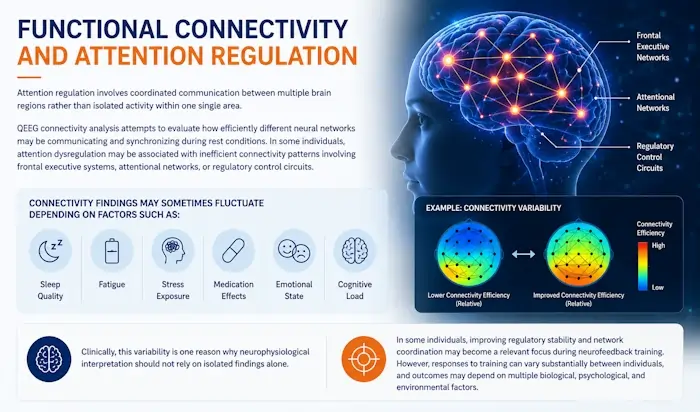
Clinically, this variability is one reason why neurophysiological interpretation should not rely on isolated findings alone.
In some individuals, improving regulatory stability and network coordination may become a relevant focus during neurofeedback training. However, responses to training can vary substantially between individuals, and outcomes may depend on multiple biological, psychological, and environmental factors.
ADHD in Children and Adults
Attention-related dysregulation may present differently across developmental stages.
In children, difficulties may more commonly involve:
- impulsivity
- behavioral inhibition
- emotional reactivity
- sustained attention
- academic inconsistency
In adults, presentations may sometimes involve:
- cognitive fatigue
- executive dysfunction
- organizational difficulties
- emotional overwhelm
- chronic stress dysregulation
- attentional inconsistency under cognitive load
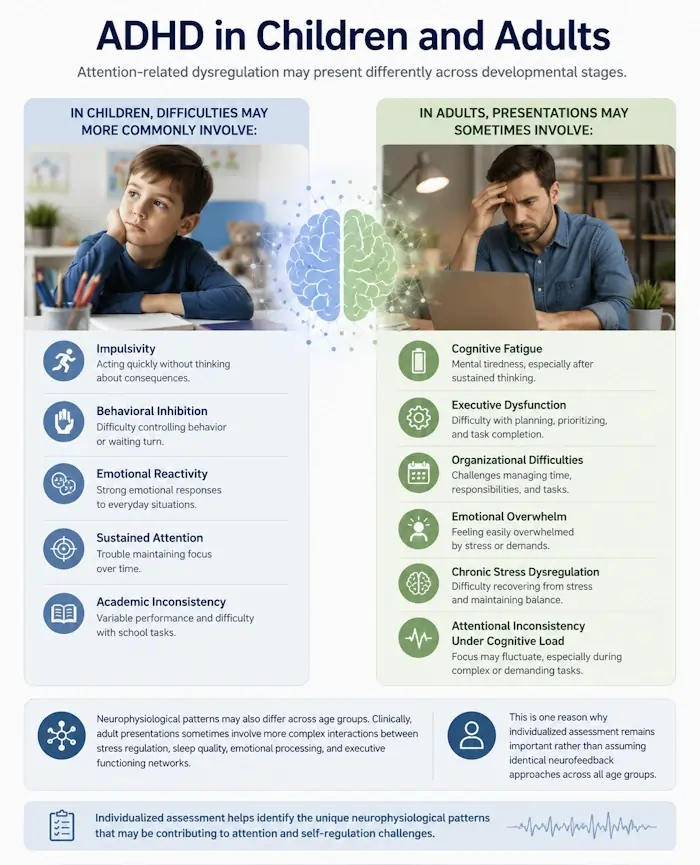
Neurophysiological patterns may also differ across age groups. Clinically, adult presentations sometimes involve more complex interactions between stress regulation, sleep quality, emotional processing, and executive functioning networks.
This is one reason why individualized assessment remains important rather than assuming identical neurofeedback approaches across all age groups.
Neurofeedback and Medication
Neurofeedback is not typically presented as a direct replacement for medical care or medication management.
Some individuals pursue neurofeedback while continuing medication treatment, while others may explore neurofeedback as part of a broader self-regulation strategy. In practice, approaches vary substantially depending on clinical history, symptom severity, medical supervision, and personal treatment goals.
QEEG findings should not be interpreted as standalone medical diagnosis, and neurofeedback decisions are generally best considered within broader clinical context when appropriate.
Is Neurofeedback a Cure for ADHD?
Neurofeedback should not be presented as a guaranteed cure for ADHD or attention-related dysregulation.
Responses to neurofeedback vary considerably between individuals. Some individuals report improvements in areas such as attentional consistency, emotional regulation, cognitive endurance, sleep quality, or stress tolerance over time, while others may experience more modest or variable changes.
Clinically, outcomes may depend on multiple interacting factors, including:
- underlying neurophysiological patterns
- training consistency
- sleep quality
- stress exposure
- emotional functioning
- developmental history
- overall health status
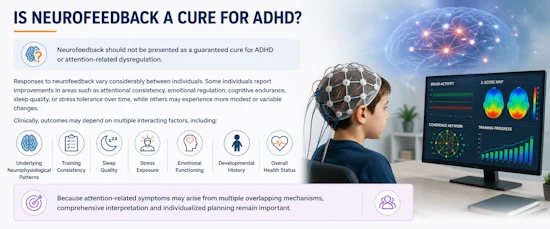
Because attention-related symptoms may arise from multiple overlapping mechanisms, comprehensive interpretation and individualized planning remain important.
Individuals researching common questions about neurofeedback, QEEG brain mapping, and individualized training approaches may also find our questions about QEEG and neurofeedback page helpful.
Potential Goals of QEEG-Guided Neurofeedback
Potential goals of individualized neurofeedback may include supporting:
- attention regulation
- executive functioning
- emotional regulation
- cognitive flexibility
- stress resilience
- sleep stability
- self-regulation capacity
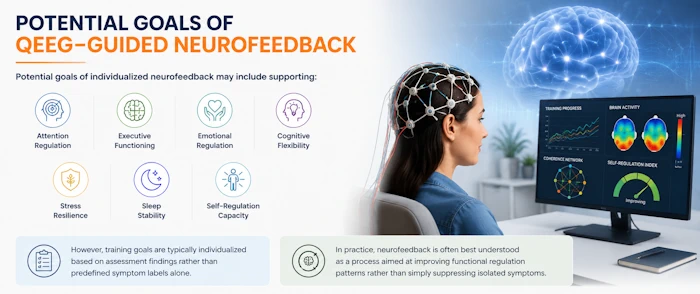
However, training goals are typically individualized based on assessment findings rather than predefined symptom labels alone.
In practice, neurofeedback is often best understood as a process aimed at improving functional regulation patterns rather than simply suppressing isolated symptoms.
Final Considerations
QEEG-guided neurofeedback attempts to integrate objective EEG analysis with individualized functional interpretation. Rather than assuming that all attention-related difficulties arise from identical mechanisms, this approach emphasizes variability between individuals and the importance of network-level assessment.
Clinically, experienced practitioners often observe that similar behavioral presentations may involve substantially different underlying regulation patterns. This is one reason why individualized interpretation, cautious clinical reasoning, and functional context remain important when developing neurofeedback protocols.
Additional information regarding neurofeedback research and neuroregulation methodologies can be found through the International Society for Neuroregulation & Research (ISNR).
This article is intended for informational and educational purposes only and should not substitute for individualized medical evaluation, diagnosis, or treatment advice.
Reviewed and published by Chiang Mai Neurofeedback Center, a neurofeedback and QEEG clinic in Chiang Mai, Thailand specializing in individualized neurofeedback protocols, functional connectivity assessment, and brain regulation analysis.